
One operational picture
Machine, meter and sensor data from every site arrives in a single platform instead of separate SCADA islands and spreadsheets.
Industry 4.0 solutions
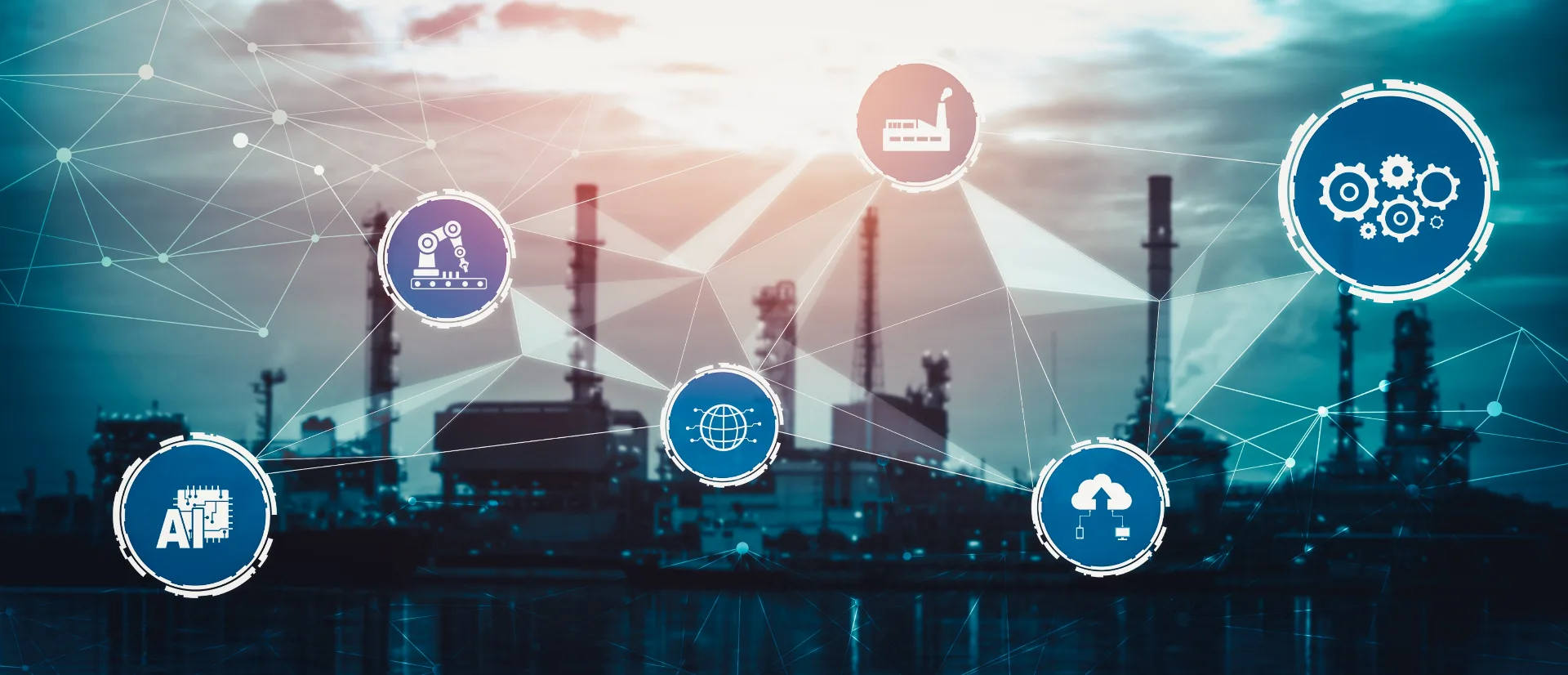
NET WIZARDS connects field devices, existing control systems, edge computing and cloud platforms into one operational fabric, so plants and utilities across the UAE and GCC can see, understand and act on their process data without replacing what already works.
The value of a connected plant is not the technology itself. It is that operations, maintenance and management teams work from the same evidence, at the moment decisions are taken.
Machine, meter and sensor data from every site arrives in a single platform instead of separate SCADA islands and spreadsheets.
Analytics run next to the process, so local action does not wait for a cloud round trip or a stable backhaul link.
Vibration, current and thermal trends show how equipment is behaving before a stoppage forces the decision.
Protocol conversion brings legacy PLCs, RTUs and meters into the new architecture without replacing working control systems.
The challenge
Most industrial operations across the MENA region still rely on isolated PLCs, legacy SCADA systems, and manual reporting workflows. These fragmented environments limit visibility, slow decision‑making, and prevent organizations from unlocking the full value of their operational data.
NET WIZARDS bridges this gap by delivering a unified Industry 4.0 ecosystem that connects field devices, edge intelligence, and cloud platforms into one seamless operational fabric. Our architecture eliminates silos, modernizes legacy infrastructure, and enables real‑time insights across utilities, manufacturing, smart cities, and critical infrastructure.
In practice this shows up as reports assembled by hand, alarms that arrive after the event, maintenance planned on calendars rather than condition, and energy costs that cannot be traced back to a machine or a shift. The engineering task is rarely to start again. It is to connect what exists, add measurement where it is missing, and put the result in one place.
Capabilities
Each capability is delivered by hardware, edge software and platform services that NET WIZARDS specifies, integrates and supports as one system.
Sub‑second telemetry from PLCs, sensors, and meters across distributed sites delivers continuous visibility into asset performance and environmental conditions.
Run anomaly‑detection, machine‑learning, and computer‑vision models directly at the edge, eliminating cloud round‑trips and enabling instant local decision‑making.
Advanced vibration, current, and thermal analytics forecast equipment failures before they occur, reducing downtime and extending asset lifespan.
Native OPC‑UA, Modbus, and MQTT bridges integrate effortlessly with existing SCADA stacks, ensuring compatibility with both legacy and modern industrial systems.
Create real‑time digital replicas of critical assets and processes to simulate performance, optimize operations, and test scenarios without disrupting live systems.
Enterprise‑grade encryption, role‑based access control, and tenant isolation ensure secure, scalable deployments across utilities, municipalities, and industrial networks.
Solution architecture
Data moves upward through five layers. Control authority stays in the control layer. Everything above it reads, normalises, analyses and publishes.
Sensors, meters, drives, instruments and machines across plants, utilities and infrastructure sites.
Existing PLCs, RTUs, SCADA and BMS systems remain in place and keep control authority over the process.
Industrial gateways and edge computers normalise protocols, buffer data and run anomaly detection and vision models on site.
Deterministic industrial networking and wireless backhaul carry selected data out of the plant to the platform.
Cloud services store history, model assets, raise alerts and publish dashboards, reports and APIs to business systems.
Diagram described in text so the structure is readable by every visitor and by search engines. Site specific drawings are produced during the design stage.
Applications
Line and machine monitoring, energy per unit produced, quality events and maintenance planning across production areas.
Industry detailRemote well, tank and pipeline telemetry over wireless or satellite links, with edge buffering where connectivity is intermittent.
Industry detailMetering, substation and pumping data brought into one platform for load visibility, loss investigation and asset condition.
Industry detailConveyor, material handling and facility equipment monitoring, plus condition data from mobile and fixed assets.
Industry detailCritical plant monitoring for chillers, air handling, medical gas and power systems, with alerting to facility teams.
Industry detailMunicipal infrastructure telemetry feeding the same platform used by utilities and industrial operators.
Industry detailTechnical deployment
Performance depends on the assets, the network and the process. Every project starts with an engineering assessment and ends with agreed acceptance criteria.
Modbus RTU and TCP, M-Bus, OPC-UA, BACnet, MQTT and Sparkplug B, with mapping documented per asset so every tag has a known source.
DIN rail gateways and fanless edge computers sized for the site, with local storage, store and forward buffering and container based analytics.
Segmented networks, outbound only connections where required, encrypted transport, role based access and tenant isolation for multi site programmes.
Commissioning tests per asset, acceptance criteria agreed before handover, remote diagnostics and a documented escalation path.
Delivery path
We survey assets, control systems, network paths and reporting needs, then agree which data has operational value.
Tag lists, gateway placement, protocol mapping, network routes, security boundaries and platform structure are documented.
One line, site or asset group is instrumented and validated against the agreed acceptance criteria.
The validated pattern is repeated across remaining sites, with configuration managed centrally.
Dashboards, alerting and reports are handed to your teams, with support, tuning and periodic review.
Industry 4.0 programmes are usually delivered alongside our Industrial Cloud platform, wireless technologies and R and D services. The gateways, edge computers and industrial networking hardware used in these projects are listed under products.